Troubleshooting Emergency Indoor and Outdoor Lighting Problems
Emergency lighting problems require checking the power source, switches, controls, fixtures, wiring, and batteries; GMB Electric diagnoses unsafe faults and restores indoor, outdoor, landscape, security, and life-safety lighting.
Request an EstimateWhat Counts as an Emergency Lighting Problem?
Emergency lighting problems are faults that leave a required, safety-related, or essential light or alarm device unreliable, dark, flickering, or unable to operate when needed.
Indoor lighting, outdoor lighting, security lighting, smoke detectors, and fire alarms can all become urgent when their failure affects safe movement, visibility, warning, or security. GMB Electric finds the cause and restores the affected building electrical system.
Which Signs Show That Lighting Needs Troubleshooting?
Lighting needs troubleshooting when a symptom suggests a power fault, damaged component, unsafe connection, or failed life-safety device. Stop using equipment that shows heat, smoke, water damage, or exposed wiring.
Our team treats these symptoms as clues, not as proof of a failed lamp. We trace the fault through the circuit, control, fixture, and wiring before choosing a repair.
What Causes Emergency Indoor and Outdoor Lighting Failures?
Emergency indoor and outdoor lighting failures usually begin with power delivery, control equipment, wiring, fixture components, or backup power. We identify which part is failing before work begins.
Outdoor equipment also faces moisture, temperature changes, and damage near buried cable routes. Our crew checks these conditions along with the electrical panel and circuit protection.
How Can You Troubleshoot a Nonworking Light Safely?
You can safely check the switch, breaker position, control settings, and visible fixture condition, but GMB Electric should diagnose energized wiring, repeated breaker trips, burning smells, water intrusion, or ladder-access problems.
These checks help separate a control problem from a circuit problem without exposing you to unnecessary risk. We use electrical testing when the fault is inside the circuit or fixture.
How Do You Respond to Outdoor Lights That Stop Working?
Outdoor lights that stop working should be checked at the control, breaker, fixture, and visible cable locations, while moisture, damaged wiring, and buried-cable faults require GMB Electric's electrical troubleshooting.
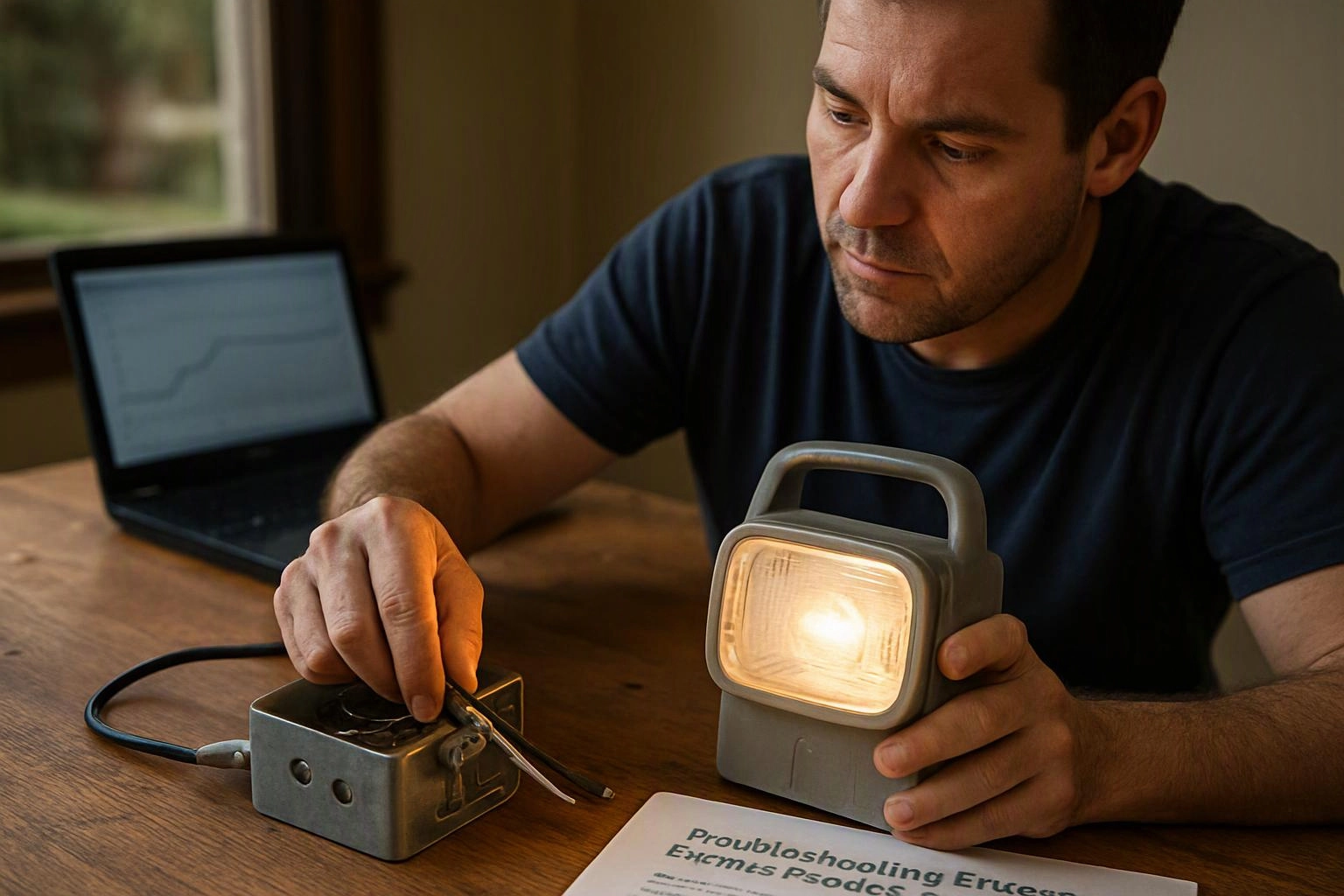
Check whether the photocell is blocked, whether the timer has the correct setting, and whether the circuit breaker has tripped. Do not open a wet weatherproof fixture or dig near an underground cable.
Landscape lighting and security lighting can share control equipment or circuit protection with other outdoor loads. We test for moisture intrusion, damaged underground cable, loose connections, and failed components before recommending repair or replacement.
Our Outdoor Lighting Installation work can also address fixture placement, weather protection, controls, and cable routing when repair is not the right solution.
What Should You Do When a Smoke Detector Stops Working?
A nonworking smoke detector should be tested, checked for a depleted backup battery, and inspected for power or interconnection faults; GMB Electric should handle hardwired detector and fire alarm wiring problems.
Press the test button and listen for the alarm sound. Replace a depleted battery when the detector design allows it, then test the device again.
A hardwired detector may stop working because of lost circuit power, a loose connection, or a problem with interconnected alarms. We trace the supply and interconnection wiring and check the fire alarm system for safe operation.
Do not leave a smoke detector disconnected because of nuisance alarms. Contact us when the alarm remains silent, chirps after a battery change, or affects other hardwired detectors.
When Does a Lighting Problem Need Immediate Electrical Help?
Lighting problems involving sparks, heat, smoke, exposed conductors, water, shock, or repeated breaker trips require stopping use of the affected circuit and contacting GMB Electric for electrical troubleshooting.
Turn off the affected control only when you can do so safely, keep people away from the area, and avoid touching wet equipment. Do not investigate a suspected energized fault yourself.
Our crew uses safe isolation before examining a damaged light fixture, switch, junction box, or wiring. We also check circuit protection so the repair addresses the hazard and not only the visible symptom.
How We Diagnose and Repair Emergency Lighting Faults
GMB Electric diagnoses emergency lighting faults by tracing power, controls, protection, fixtures, and wiring in a safe sequence. Our process helps us select a repair that matches the actual failure.
Repair cost depends on the fault location, access, damaged parts, wiring condition, and whether the system needs replacement or correction. We provide an estimate based on the conditions found during troubleshooting.
How Can You Prevent Future Indoor and Outdoor Lighting Problems?
Future indoor and outdoor lighting problems can be reduced through routine checks, suitable equipment, and timely repairs. Our team can identify conditions that place repeated stress on lighting circuits.
Prevention is most effective when the lighting system is checked as a complete circuit. We can inspect the controls, wiring, fixtures, and protection that support dependable operation.
Get Help With Emergency Lighting Problems
GMB Electric provides electrical troubleshooting for emergency lighting problems involving indoor lighting, outdoor lighting, landscape lighting, security lighting, smoke detector systems, and fire alarm wiring.
We also handle Indoor Lighting Installation, Outdoor Lighting Installation, landscape lighting installation, security lighting installation, smoke detector installation, and fire alarm installation when a failed system needs a lasting correction.
Tell us what happened, which fixtures or alarms are affected, and whether you noticed sparks, heat, smoke, water, or a tripped breaker. We will explain the required checks and the repair estimate for the conditions we find.
Questions About Emergency Lighting Problems
Why do outdoor lights stop working after rain?
Outdoor lights can stop working after rain when moisture reaches a fixture, connection, control, or underground cable. GMB Electric checks for water intrusion, damaged seals, corrosion, and circuit faults before restoring the lighting.
Why does an emergency light stay on or fail its test?
An emergency light can stay on or fail its test because of a charging fault, backup battery problem, control issue, or wiring fault. We test the supply, charging circuit, battery backup, and fixture operation.
Can a tripped breaker cause several lights to stop working?
Yes, a tripped breaker can stop power to multiple lights when those lights share the same circuit. Do not keep resetting the breaker if it trips again; we diagnose the circuit and connected equipment.
Why does a smoke detector chirp after a battery change?
A smoke detector can chirp after a battery change because the battery is not seated correctly, the detector has stored a fault, or the hardwired supply has a problem. We inspect the detector, power connection, and alarm wiring when the chirp continues.
Can one failed hardwired smoke detector affect interconnected alarms?
Yes, one failed hardwired smoke detector can affect interconnected alarms when the shared power or interconnection wiring has a fault. We test the affected detector and the connected alarm circuit to locate the problem.
Related Resources
Emergency Electrician Cost Factors: What Affects a 24-Hour Electrical Repair Quote?
Everything About ItHow to Choose an Emergency Electrician in Indianapolis
Compared ToLocal Specialist vs National Electrical Troubleshooting Providers in Indianapolis: Cost & Service Compared
What Goes With ItHow Emergency Electrical Troubleshooting Finds Intermittent Problems