Skip to content

Bidirectional Charging System Troubleshooting in Clermont, Indiana

Communication failure often decides why power won't transfer in Clermont. We trace the charger link and check the related control parts.

Licensed & InsuredWarranty AvailableSame-Day ServiceUpfront, Transparent Pricing

Quick Summary: Bidirectional Charging Troubleshooting in Clermont, Indiana

Bidirectional charging system troubleshooting in Clermont is provided by GMB Electric for homes and businesses across Indianapolis and surrounding communities. The service covers charger communication, inverter faults, transfer relays, and firmware issues during 24-hour electrical service.

  • What we do: GMB Electric provides Bidirectional charging system troubleshooting for homes and businesses in Clermont, Indiana.
  • What is included: GMB Electric checks charger communication, grid settings, inverter faults, transfer relays, and firmware issues.
  • What you get: The customer receives a clear finding about why power is not transferring and what electrical work should follow.

Why is my bidirectional charger not transferring power?

Communication failure is a leading cause when a bidirectional charger won't transfer power. The charger, vehicle link, inverter signals, grid settings, transfer relay, and firmware need a careful check before repair decisions are made.

Bidirectional charging system troubleshooting and local service scope

Bidirectional charging system troubleshooting focuses on a charger that cannot send or receive power as expected. The work suits homeowners, property managers, and businesses using vehicle-to-home or vehicle-to-building equipment.

The key decision is whether the fault sits in the communication path, the power path, or the control settings. We trace those areas in order, then explain which repair or adjustment fits the finding.

This page serves customers in Clermont who need a focused diagnosis for power transfer problems. It does not replace a full panel upgrade, new EV charging installation, or unrelated wiring repair when those are the real source of the issue.

  • Check whether the charger and vehicle exchange the needed control signals.
  • Review grid settings that affect permitted power flow.
  • Test inverter behavior and transfer relay operation.
  • Check firmware status when control faults remain.
  • Separate a charger fault from a panel, wiring, or service entrance issue.
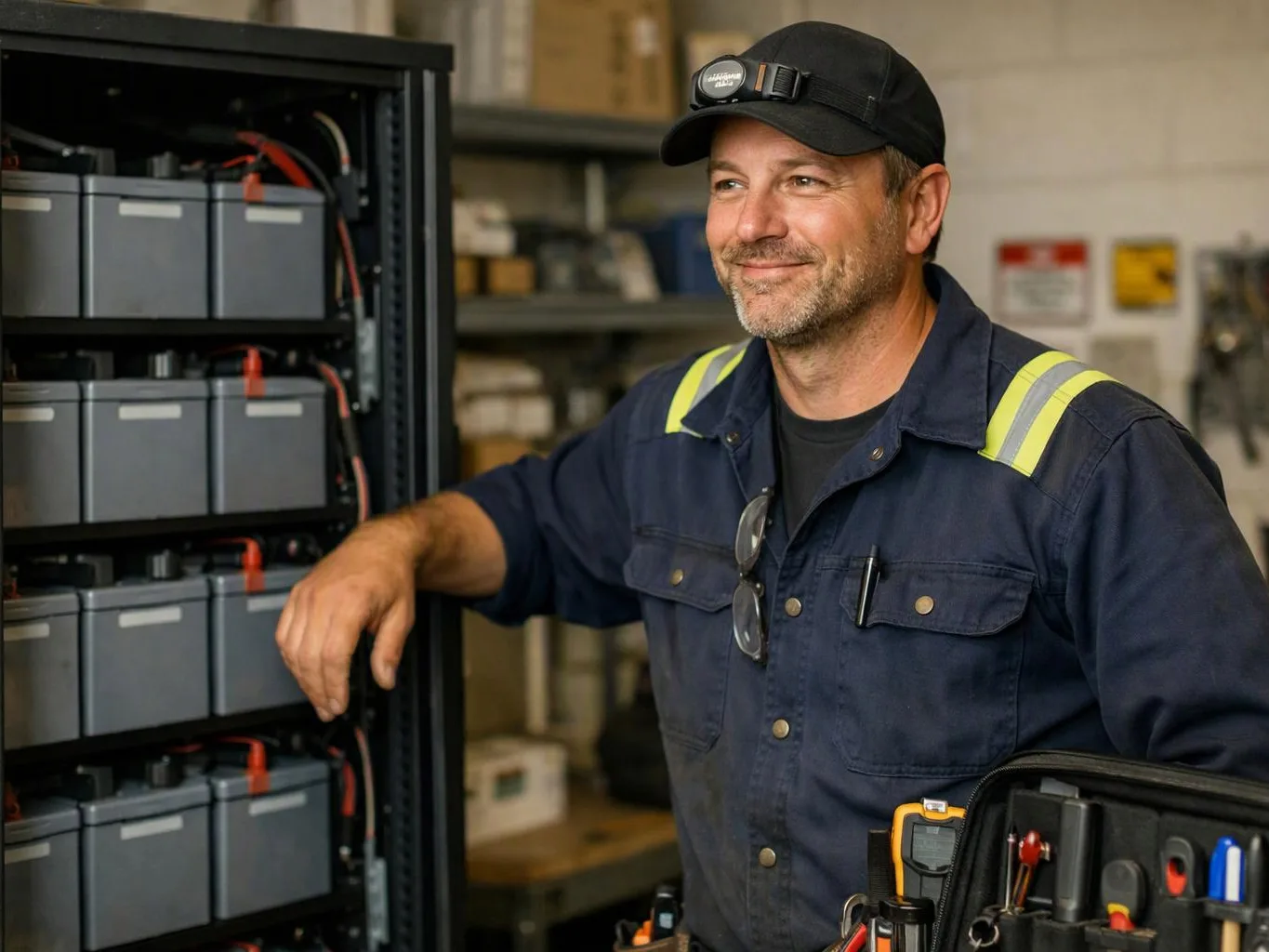
A smiling worker in a dark uniform stands beside stacked batteries in a workshop setting

Service Overview

Bidirectional charging system troubleshooting is an electrical service that finds why power will not move between a vehicle, charger, property, and grid connection.

  • This work differs from a standard EV charging installation because it tests power flow in both directions and checks control signals.
  • GMB Electric provides this service for homes and businesses in Clermont.
Process

How we trace a bidirectional charging fault

1

Record the transfer symptom

We note what the charger does, what the vehicle reports, and whether power moves in either direction.

2

Check the communication link

We inspect the charger and vehicle connection, then look for lost control signals or fault messages.

3

Review grid settings

We check settings that govern permitted power flow and compare them with the system's intended operation.

4

Test inverter and relay control

We test inverter signals and transfer relay behavior to find where the power path stops.

5

Review firmware concerns

We consider firmware issues when communication and electrical checks do not explain the fault.

6

Explain the next electrical step

We describe the finding and identify whether the next step is a repair, adjustment, installation, or broader electrical assessment.

What you get from a focused charging fault check

A decision based on system tests

The diagnosis follows the path from charger communication to power transfer. We check the part that controls the symptom before discussing the next step.

A clear boundary around the repair

A bidirectional charger fault may need equipment or control work. If the issue is a wider panel, service entrance, or wiring problem, this focused check is only the starting point.

Residential and commercial fit

We support homes and businesses with electrical troubleshooting, planned upgrades, installations, and inspections. The site type helps shape access and testing needs.

When this service is the right fit

A property in Clermont may have a charger that powers the vehicle but will not send energy back to the building. We isolate the control path, check the inverter and relay, then explain whether the issue belongs to the charging system or the property's electrical equipment.

What this charging diagnosis changes for you

You learn whether the fault affects communication, power flow, or control settings.

A focused diagnosis helps separate an equipment issue from a panel or wiring problem.

Testing gives you a clearer basis for repair, adjustment, or replacement decisions.

The work helps protect against repeated resets that do not address the source of the fault.

Homeowners and businesses get recommendations tied to the actual charging behavior.

What bidirectional charging troubleshooting includes

GMB Electric provides comprehensive Bidirectional charging system troubleshooting in Clermont. Here's what you get:

  • We inspect the charger connection and the vehicle-to-charger communication path.
  • We check grid settings that control when power may move in either direction.
  • We test inverter signals and look for fault conditions that stop transfer.
  • We inspect the transfer relay and related switching controls.
  • We review firmware issues when the equipment reports a control or connection fault.
  • We explain the finding and outline the next electrical step.

Charging fault areas we compare during diagnosis

The table shows how each fault area affects the next testing decision.

Fault areaWhat the symptom may showWhat we check next
Communication pathThe vehicle and charger do not exchange the needed control signal.We check connections, status messages, and control communication.
Grid settingsThe system blocks transfer under its present operating rules.We review permitted power flow and related settings.
Inverter faultThe system receives a command but cannot change power flow.We check inverter fault signals and response.
Transfer relayThe control path works but the switching path does not complete.We test relay operation and related connections.
Firmware issueThe system reports a control fault after basic electrical checks.We review firmware concerns with the equipment status and wiring findings.

The GMB Electric Standard

  • Urgent Assistance
  • Problem Diagnosis
  • Safe Repairs
  • Clear Communication

Questions about bidirectional charging faults

Which part of the property decides the troubleshooting scope?

The electrical service, panel, charger circuit, and transfer equipment decide the troubleshooting scope. A charger fault may stay within the equipment connection, while a panel or service entrance issue expands the work. We inspect the power path and control path together. Access to the charger and electrical panel helps us define the proper assessment.

What material changes how this charging fault is checked?

The wiring and connection materials affect how we trace the charging fault. Copper conductors, aluminum conductors, terminals, conduit, and the charger connection each require close inspection. We check terminations, grounding, and signs of heat at the relevant points. The equipment layout also affects which parts we can test directly.

How does a troubleshooting visit move from the first call to the last step?

The visit moves from symptom review to control checks, power-path tests, and a written explanation of the next step. We record the transfer behavior first. Then we check communication, grid settings, inverter signals, relay operation, and firmware concerns. The final discussion separates a focused repair from a wider electrical project.

When does a charger fault point to a panel problem?

A charger fault points to the panel when the circuit, breaker, wiring, or service supply cannot support the intended transfer. Repeated trips, dead equipment, heat, or unstable voltage raise that concern. We inspect the charger circuit and panel before assigning the fault to software or communication. A panel upgrade may be a separate project when capacity is the issue.

Which warning signs make reverse charging urgent?

A burning smell, buzzing panel, sparking connection, or repeated breaker trip makes the electrical problem urgent. Stop using the affected equipment if it shows a fire hazard or damaged connection. We handle urgent electrical calls and inspect the source before power is restored. Do not remove covers or reset a fault repeatedly.

What should I share before requesting this assessment?

The charger model, vehicle model, warning message, recent change, and a photo of the display help frame the assessment. Do not open the charger or panel to gather details. We can use the symptom and available access information to plan the inspection. Keep the equipment off if it shows heat, smoke, sparks, or a burning odor.
Contact

Request a bidirectional charging troubleshooting estimate in Clermont

Ask GMB Electric for a free estimate on your charging fault assessment, and urgent requests get priority scheduling.

A beige sofa sits beneath a ceiling fan, with a floor lamp glowing beside it in a plain room

Bidirectional charging system troubleshooting in Other Areas

(317) 608-1220